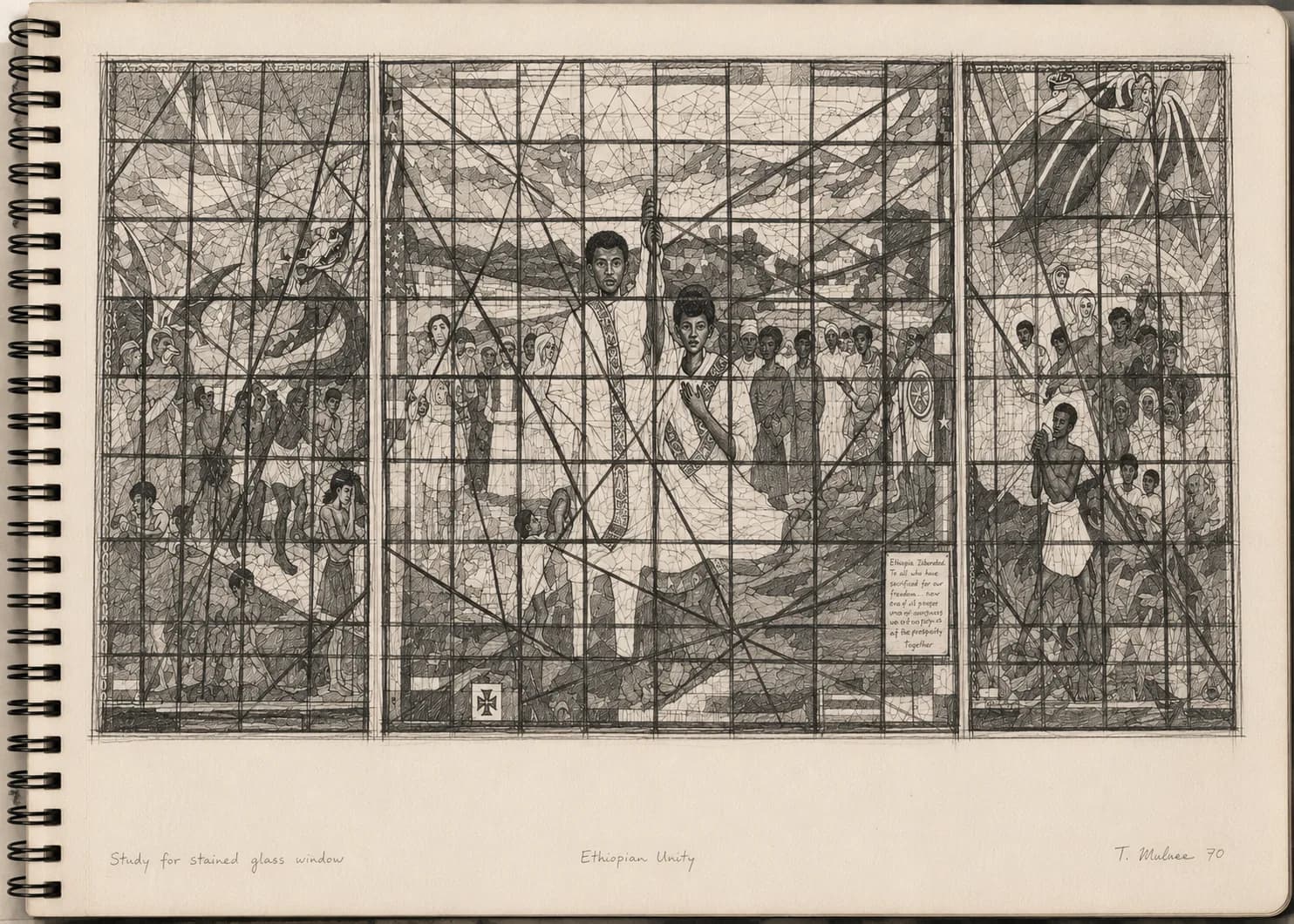
Africa Hall Windows
The most significant public commission of Afewerk Tekle's career, and one of the largest works of stained glass produced in the twentieth century by any artist anywhere in the world. Three vast windows — each over fifteen metres tall — face the entrance hall of Africa Hall, the Addis Ababa headquarters of the United Nations Economic Commission for Africa. They tell the story of the African continent: its past, its colonial wound, its independence, and its future.
Curatorial NoteOn the work
Afewerk designed the windows in 1959 and spent three years supervising their fabrication at Studio Atelier Thomas Vitraux in Valence, France. The glass itself is of a quality and variety rarely seen in secular architecture: over forty distinct colours, including several shades developed specifically for this commission to capture the colours of the Ethiopian landscape — the specific blue of Lake Tana, the specific ochre of Lalibela stone, the specific green of teff in the rains.
The central window, measuring approximately 75 square metres, depicts the history of Africa from ancient Egypt through colonisation to independence. The flanking windows extend the narrative into the present and the future. The overall effect, particularly in the early morning when the east-facing windows catch the first light, is overwhelming — the hall fills with colour as a cathedral fills with music.
The windows are Afewerk's greatest achievement in the medium and, many argue, his greatest achievement in any medium. They have been described by the architectural historian Kenneth Frampton as "one of the defining works of public art of the twentieth century."